

 06 May, 2026
Following the final data cut-off, the advanced manufacturing and machine tool sector has confirmed the slight slowdown already anticipated in the provisional figures. Revenue has reached 2,247.6 million euros, which is a 3.27% drop compared to 2024. Exports, meanwhile, have remained stable, with an increase of 0.82% to 1,763.8 million euros.
When analysing the figures by subsector a clearly uneven trend becomes apparent. The metal cutting sector, with a wider range of customer sectors, some of which are currently experiencing growth, has seen positive results, with a 1.56% increase in turnover, whilst the metal forming sector continues to be affected by the situation in the European automotive industry and fierce competition from China, recording an 11.93% decline. Among the other subsectors, components continued to perform well (+2.64%), whereas cutting tools (-6.94%) ended the year in negative territory.
As for the main export destinations, the United States ranks as the leading market with 13.66% of the total figure, closely followed by Germany (12.67%) and Mexico (9.01%). These are followed by Italy (8.48%), China (5.53%), France (5.49%), Portugal (3.92%), Canada (3.86%) and India (3.82%).
“The 2025 year-end figures reflect a highly challenging environment, in which strong export performance has helped to maintain turnover levels, particularly in metal cutting. We are operating in a highly uncertain environment, characterised by challenges in key sectors and growing tensions in the major international markets. The war in Iran is reigniting inflationary risks caused by restrictions on international oil and gas trade, which are spilling over into other products and could exacerbate supply shortages.
Europe, our main area of activity, continues to show signs of weakness in some of its key industries, whilst China, which is becoming increasingly selective in its imports, is consolidating its position as a global competitor. For its part, the United States, despite its controversial international conduct, remains a strategic market for us, whilst India, although its import capacity is still limited, is gaining prominence as an emerging market with considerable potential.
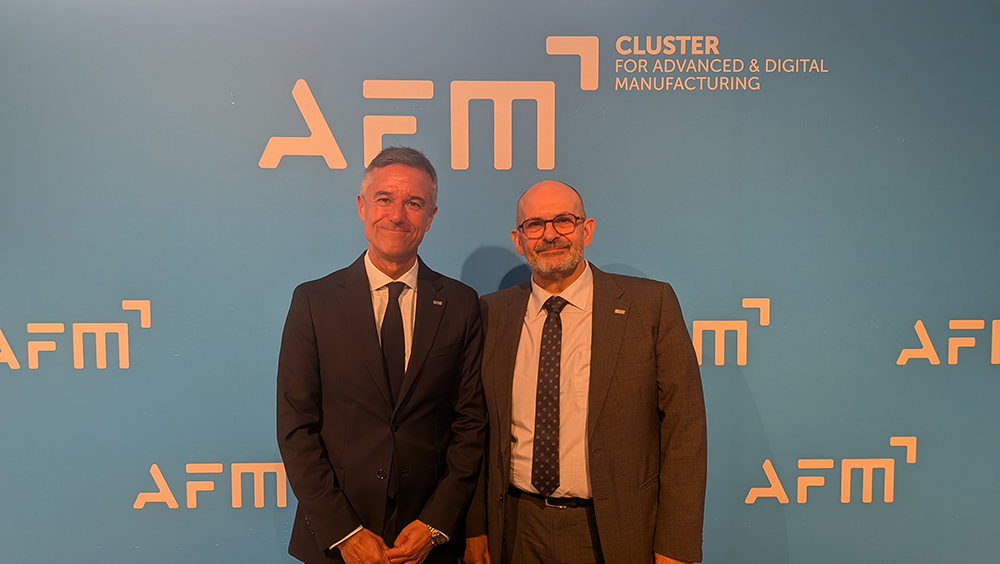
Nevertheless, the sector continues to work towards the future, focusing on innovation, technology and helping our businesses adapt more quickly”, says José Pérez Berdud, President of AFM Cluster.
2025 ORDERS AND 2026 FORECAST
In 2025, orders increased by 2.29% with respect to the prior year. The metal cutting subsector achieved an all-time high with a 21.54% increase in incoming orders, providing it with a solid portfolio to underpin its operations in the coming months. For its part, the metal forming subsector continued to decline, sustaining its production activity through the use of existing stock.
In the domestic market, orders rose significantly (+41.47%), a figure that could help drive a recovery in consumption, whilst international markets saw a slight decline of 1.65%. Despite this, Europe recorded growth of 17.5% and North America grew by 4.3%, with the United States being the main source market, accounting for around 22% of the total. In contrast, China, now in fifth place, and accounting for only 3.9% of total 2025 orders, dropped by 1.20%.
In the ranking of buyer countries, as mentioned, the United States clearly headed up the list, followed by Germany, Italy, France, China, Mexico, Poland, Türkiye, the Czech Republic and India, which made up the top ten sources of orders.
In the words of Xabier Ortueta, CEO of AFM Cluster:
“The sector has faced a particularly complicated year. The metal cutting subsector has performed very strongly, driven by a reduction in the number of highly complex projects involving significant technological risk and large sums of money. In the context of this highly volatile market, it has reached an all-time high in orders. Metal forming, meanwhile, has also seen a significant drop in orders in 2025, largely due to the situation in the automotive sector and growing competition from China, with prices previously unseen in the market”.
The start of 2026, with the first quarter now complete, shows order figures very similar to those for the same period in 2025, with a similar trend across subsectors, where metal cutting continues to perform well while metal forming remains in a worrying situation.
“Metal cutting must continue to capitalise on the current momentum and build on its strong position within various key industries to maintain an adequate level of incoming orders. Metal forming is facing a downturn that, given the investment trends in the automotive sector, appears to be structural, and decisions regarding transformation, diversification and repositioning will have to be made”, explains the CEO of AFM Cluster.
CHINA, THE WORLD’S NEW ECONOMIC POWERHOUSE, AND EUROPE’S ESSENTIAL RESPONSE
China has established itself as an increasingly influential player on the international machine tool market, driving a strategy of technological advancement based on its strong presence in the country’s manufacturing sectors, which, due to their scale, exacting standards and pace, significantly accelerate the learning curve. We also observed a clear government policy of supporting the replacement of imports with domestic products, and a determined drive to establish a foothold in international markets with value-added products that are extremely competitive on price. These dynamics are having a direct impact on incoming orders from Western manufacturers in certain sectors. This situation poses significant challenges for European industry, which is being forced to double down on its efforts in terms of competitiveness, innovation and adaptability in order to maintain its position.
Xabier Ortueta, CEO of AFM Cluster: “The rise of Chinese industrial products is a global reality. Their entry into international markets with value-added products at very low prices presents us with a formidable competitor. To respond to this, our companies must continue to invest, transform themselves and embrace technology, without neglecting diversification. At the same time, strong support from the authorities is essential: firstly, to protect the industry so that fair competition can prevail; secondly, to regulate the entry of both Chinese products and companies under conditions that are comparable in every respect to those of other market players and to those imposed by China itself; and, thirdly, to provide the necessary resources, in a timely manner and on a sufficient scale, to strengthen our competitiveness.”
The sector is calling for a swift, coordinated response at European level to strengthen the industry and restore its leadership. Protecting strategic sectors, boosting investment in sectors with a promising future and harmonising areas such as defence, the labour market and the financial sector are essential. In addition, we must consider the hitherto unseen pace (which raises the question of whether the outdated processes for adopting agreements should be revised), abundant resources and regulation that supports competitiveness without inhibition.
José Pérez Berdud, president of AFM Cluster: “Europe needs greater unity, ambition and leadership to strengthen its industry and tackle this new global landscape, and it must do so swiftly and with determination. Now is the time to identify strategic sectors and implement measures to drive their development. We must be highly competitive without compromising our values, championing a model that combines economic progress, social cohesion and freedom.”
INDUSTRY SUMMIT
On 3 June, Madrid will host the third edition of the Industry Summit, an event that will once again bring together experts, companies and key technologies to examine the major challenges facing advanced manufacturing. The event, organised by AFM Cluster, will address in its programme some of the issues shaping the sector’s development, such as robotics applied to industry, China’s impact on the global industrial landscape and the strategic role of the defence industry. The days events will begin at 9.30 am with a presentation by Xabier Ortueta on the state of the sector in Spain, followed by a session focusing on the factory of the future, with a particular emphasis on robots and humanoids, and will conclude with panel discussions, success stories and a networking session.
Subscribe to our newsletter. Just insert your e-mail and you will receive the latest news.